

How Long Can a Convertible Trike Grow with Your Child from 1 to 4 Years?
Choosing a riding toy for a rapidly growing toddler can feel like a race against time. The toddler tricycle that fits them today might be too small in a year. This is where the convertible trike comes in, promising to be the one and only riding toy your child needs from their first birthday to their fourth. But can one product truly adapt to three full years of developmental leaps?
This guide will break down the stages and features to show you how long a convertible trike can realistically grow with your child. However, it is worth noting that while versatile, many experts suggest a balance bike offers unique benefits for developing coordination that a trike cannot.
What Is a Convertible Trike, Exactly?
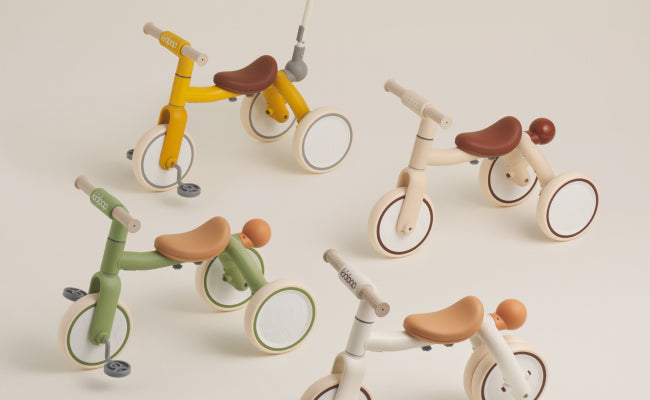
A convertible trike is a multi-stage riding toy designed to evolve with a child's skills. It starts its life as a parent-pushed stroller-alternative and gradually sheds its support features—like the parent handle, safety harness, and footrests—to transform into a classic, independent toddler tricycle. This adaptability is its key selling point, offering a single solution that bridges the gap between a stroller and a first bike. The most common version is the toddler tricycle with handle, which forms the foundation of its design. Understanding these early stages can help you choose the best ride-on toys for your child's development.

Understand the 1–4 Year Development Window
To appreciate how a convertible trike works, it's crucial to understand the incredible changes a child undergoes between their first and fourth birthdays.
- Age 1: A child is typically a passive passenger. They can sit up but lack the coordination to steer or pedal.
- Age 2: Motor skills are exploding. A child is walking confidently, starting to understand steering, and may be ready to place their feet on pedals, even if they can't push them yet.
- Age 3: Coordination and strength improve dramatically. A child can now actively pedal and steer, but still benefits from parental supervision and assistance.
- Age 4: The child is an independent rider, confident in their pedaling and steering abilities, and may soon be ready for their next challenge.
A well-designed convertible trike has a distinct stage to match each of these developmental milestones.

How the Trike Adapts to Your Child
The magic of the convertible trike lies in its modular design. Here’s how it typically transforms through the years.
As a tricycle for a 1-year-old, the product functions more like a fun stroller. In this initial stage, the parent has full control. The parent handle steers the trike, the child's feet rest on foldable footrests (not the pedals), and they are secured with a safety harness or ring. This is a perfect, engaging way to go for walks while making the child feel like they are in control of their own "vehicle."
As your toddler grows, you can begin to introduce more interaction. The footrests are folded away, and you can encourage your child to place their feet on the pedals. Many convertible trikes have a feature that allows the pedals to spin freely without engaging the wheel, so their legs can go for a ride without interfering with your pushing. You might also unlock the handlebars, allowing your child to practice steering while you still have override control with the parent handle.
This is the classic tricycle for a 2-year-old phase, and it continues as they become a tricycle for a 3-year-old. The pedals are now engaged with the front wheel, and your child is learning the motion of pedaling. The parent handle is still attached, providing a safety net and a helping hand for getting started, navigating hills, or for when little legs get tired. This shared-control stage is crucial for building confidence.
Finally, the moment of independence arrives. The parent handle is detached, and the product is now a fully functional, kid-powered toddler tricycle. Your child is in complete control of steering and pedaling. They will enjoy this final stage until they either physically outgrow the frame or are developmentally ready for their next challenge, such as a balance bike or a small pedal bike. This next step often involves transitioning to a different type of ride-on, like a baby balance bike, to further develop coordination.

When Does a Child Outgrow a Convertible Trike?
While the age range of "1 to 4" is a great marketing tool, a trike's lifespan is ultimately determined by physical size, not age. Pay close attention to the manufacturer's height and weight limits.
A child has outgrown the trike when their knees come up too high and hit the handlebars, or when they look visibly cramped on the frame. An improper fit makes pedaling uncomfortable and inefficient. Always prioritize these physical cues over the age printed on the box.
Convertible Trike vs. Regular Toddler Trike: Which Offers More Value?
A regular, non-convertible toddler tricycle typically has a much shorter useful life, often only being suitable for about 18 months (e.g., from age 2.5 to 4). While it may be cheaper upfront, its cost-per-year can be higher.
A convertible trike, while more expensive initially, can offer over three years of use. It covers multiple developmental stages, potentially replacing both a secondary stroller and a standard trike. For parents looking for maximum utility and value from a single purchase, the convertible model is almost always the longer-lasting option. For example, our popular Pony 4-in-1 Kids Tricycle is designed to adapt through every one of these stages.
Your Buying Checklist: Key Features for Maximum Longevity
Not all convertible trikes are created equal. To ensure yours can truly last from age 1 to 4, look for these essential features:
- A sturdy, removable parent handle with steering control.
- An adjustable seat that can move forward and backward to accommodate growing legs.
- Foldable or removable footrests for the earliest stage.
- A secure, removable safety harness or enclosure ring.
- A pedal lock or freewheel feature to disengage the pedals in the early stages.
Maximizing Your Convertible Trike Investment: 1 to 4 Years of Use
So, how long can a convertible trike last? Truth be told, it can be safely stated that it can last in your family successfully from one year up to four years. The reason behind its durability, you may ask? This lies in its excellent versatility, which allows it to change from a parent-operated push toy to your toddler tricycle. By opting for the right one, you are making an excellent investment in something that can keep up with your child's miraculous growth process.

FAQs About Convertible Trikes and Parent-Controlled Riding
How old should my child be to start using the parent-controlled push trike mode?
The majority of babies can transition into the first stroller-style stage between 9 and 12 months. The main milestone here would be if they can sit up by themselves and be unsupported all through the walk.
If my child is already 2 years old, is it still worth getting a convertible trike?
Yes, it can still be an excellent value. You can simply bypass the first step and move right into step two with guided pedaling. You can still get at least two years of usage from needing support to becoming self-reliant, and that's more than you'd get with a traditional tricycle.
If my child is slightly over the listed height or weight limit, can they still ride the trike safely?
It is highly recommended that you stay within the limits specified by the manufacturers. The specified limits are designed with safety and structure in mind. Going over these limits can cause undue strain on your frame, leading to potential breakage and injury.
When is it essential to keep the parent handle attached on a convertible trike?
The parent handle is crucial with respect to safety in all instances when you find yourself around traffic, in an area with uneven ground, or on hills. The handle also ought to be attached at all times until your child has learned to handle steering and brakes and can safely move without supervision.
